

This article contains affiliate links. We may earn a small commission at no extra cost to you.
Hostel mess dal tastes like water. Outside food costs ₹150-₹250 per meal. And the electric kettle can only take you so far before you want actual cooked food: rice, dal, sabzi, eggs. An induction cooktop solves this, but there's a catch. Most hostels cap power at 1000W per room, and many wardens confiscate cooking appliances they haven't approved.
The right induction cooktop for hostel room runs under 1000W, heats fast enough to cook a full meal in 20 minutes, and costs under ₹2,500. This guide covers 5 models that work within hostel power limits, what you can cook on them, the utensils you need, and how much money you'll actually save each month.
Before buying, check with your hostel warden. Some hostels ban cooking appliances outright. Others allow them with wattage restrictions. Newer PGs like those in Koramangala or Malviya Nagar tend to be more flexible. One conversation saves you a confiscated cooktop and a ₹500-₹1,000 fine.
Why Induction Works Better Than a Hot Plate in Hostels
Hot plates and induction cooktops both plug into a wall socket, but they work very differently. A hot plate heats a metal coil that transfers heat to the pan. An induction cooktop generates a magnetic field that heats the pan directly. That difference matters in a hostel room.
| Feature | Induction Cooktop | Electric Hot Plate |
|---|---|---|
| Heating method | Magnetic field (pan heats directly) | Heated coil (transfers heat to pan) |
| Time to boil 1L water | 3-4 minutes at 800W | 6-8 minutes at 800W |
| Surface temperature when cooking | Cool to touch around the pan | Entire surface gets hot |
| Auto shut-off | Yes (pan removal + overheat) | Rarely (manual switch only) |
| Fire risk | Very low (no open flame, cool surface) | Moderate (hot coil exposed) |
| Cleaning | Flat glass, wipe in 30 seconds | Coil grooves trap food, 5-10 min |
| Price range | ₹1,200-₹2,500 | ₹500-₹1,200 |
| Utensil restriction | Magnetic-bottom only | Any utensil |
The hot plate is cheaper upfront, but the safety gap makes induction the clear winner for hostel rooms. A hot plate with clothes, curtains, and papers within arm's reach is a genuine fire hazard. Induction cooktops don't heat the surface around the pan, so accidental burns are nearly impossible.
The one downside: induction only works with specific utensils (more on that below). But a single compatible pan costs ₹300-₹500, so the total investment stays low.
Top 5 Induction Cooktops Under ₹2,500 (Low-Wattage Models)
| Rank | Model | Min Wattage | Max Wattage | Price | Key Feature |
|---|---|---|---|---|---|
| 1 | Prestige PIC 20.0 | 200W | 1200W | ₹1,799 | Adjustable wattage, set to 800W for hostel use |
| 2 | Bajaj Majesty ICX 7 | 300W | 1200W | ₹1,499 | Budget pick, adjustable power |
| 3 | Pigeon Favourite IC | 200W | 1200W | ₹1,299 | Cheapest option, decent quality |
| 4 | Philips Viva HD4928 | 300W | 2100W | ₹2,399 | Premium build, lock wattage at 800W |
| 5 | Havells Insta Cook PT | 200W | 1600W | ₹1,999 | Crystal glass top, energy display |
Important: All these cooktops have adjustable wattage. Set the maximum to 800W or below to stay within hostel power limits. The 1200W or 2100W is the maximum capacity; you don't have to use it at full power.
1. Prestige PIC 20.0, ₹1,799
The most popular choice for hostel rooms. The wattage selector lets you lock it at 200W, 400W, 600W, or 800W. At 800W, it boils water in 4 minutes and cooks rice in 15 minutes. The anti-magnetic wall prevents the cooktop from interfering with other electronics nearby. Compact size fits on a hostel desk. Prestige also has wide service center availability across India, which matters if something goes wrong mid-semester.
2. Bajaj Majesty ICX 7, ₹1,499
Budget-friendly and reliable. Bajaj's cooktop has a similar adjustable wattage system. The build quality is slightly below Prestige, the plastic body feels lighter. But for ₹300 less, it cooks exactly the same. Good pick if you plan to use it 3-4 times per week rather than daily. The push-button controls are simpler than the Prestige's rotary dial, which some people prefer.
3. Pigeon Favourite IC, ₹1,299
The cheapest induction cooktop worth buying. At this price point, you get basic functionality: adjustable power, auto shut-off, and a flat cooking surface. The timer and preset buttons are minimal but functional. Perfect for students who only need to cook basic dal, rice, and eggs. The downside: the crystal plate is thinner than Prestige or Philips, so it scratches more easily. Use a soft cloth for cleaning, not a scrubber.
4. Philips Viva HD4928, ₹2,399
The premium option. If you're cooking daily and want something that lasts 3-4 years of hostel life, Philips builds the sturdiest cooktop on this list. The glass surface is thicker, the buttons feel solid, and the temperature control is more precise than the budget models. You can set specific temperatures (from 60 degrees to 240 degrees Celsius) rather than just wattage levels, which makes a real difference when frying eggs or simmering dal. The 2100W maximum means you can take this home during vacations and use it as a regular cooktop. At ₹2,399, it's the most expensive pick, but the per-year cost is lower if you keep it through your entire course.
5. Havells Insta Cook PT, ₹1,999
Havells sits between the budget and premium options. The standout feature is the real-time energy display that shows you how many watts you're drawing at any moment. In a hostel where you're trying to stay under the MCB limit, this is genuinely useful. The crystal glass top looks better than Bajaj or Pigeon, and the soft-touch buttons hold up well over time. Havells service centers are common in most Indian cities, making warranty claims straightforward.
How to Choose the Right Model
With five options on the table, here's how to narrow it down based on your situation.
| Your Situation | Best Pick | Why |
|---|---|---|
| Tight budget, occasional cooking | Pigeon Favourite IC (₹1,299) | Lowest cost, handles basics well |
| Budget-conscious, 3-4 times per week | Bajaj Majesty ICX 7 (₹1,499) | Reliable at a low price point |
| Daily cooking, want durability | Prestige PIC 20.0 (₹1,799) | Best balance of price and build quality |
| Need to monitor power draw | Havells Insta Cook PT (₹1,999) | Real-time wattage display |
| Cooking daily for 3-4 years | Philips Viva HD4928 (₹2,399) | Lasts longest, precise temperature control |
If you can't decide: go with the Prestige PIC 20.0. It's the most widely owned induction cooktop in Indian hostels for a reason. Good build, easy controls, and enough power for any meal you'd cook in a room.
What You Can Cook on an Induction Cooktop in a Hostel Room
At 600-800W, cooking takes slightly longer than a kitchen stove but still delivers proper meals:
Quick meals (10-15 minutes):
- Maggi with vegetables
- Poha (beaten rice)
- Omelette or scrambled eggs
- Upma
- Boiled eggs
Full meals (20-30 minutes):
- Rice (basmati takes 15-20 min at 800W)
- Dal (moong dal in 20 min, toor dal in 25 min)
- Khichdi (one-pot meal, 25 min)
- Pasta with sauce
- Vegetable stir-fry
Slow cook (30-45 minutes):
- Rajma or chole (pre-soaked, pressure cooker needed)
- Chicken curry
- Biryani (in a pressure cooker)
A practical weekly meal plan for a student cooking on induction: make rice and dal on Sunday and Wednesday (store in a covered container), cook eggs or stir-fry for quick weekday dinners, and fall back on the mess for lunch when you're short on time. This hybrid approach balances effort, cost, and nutrition better than going fully self-cooked.
For more meal ideas with simpler appliances, check our electric kettle recipes for hostel guide. And our hostel food survival guide covers the complete food strategy including mess optimization and tiffin services.
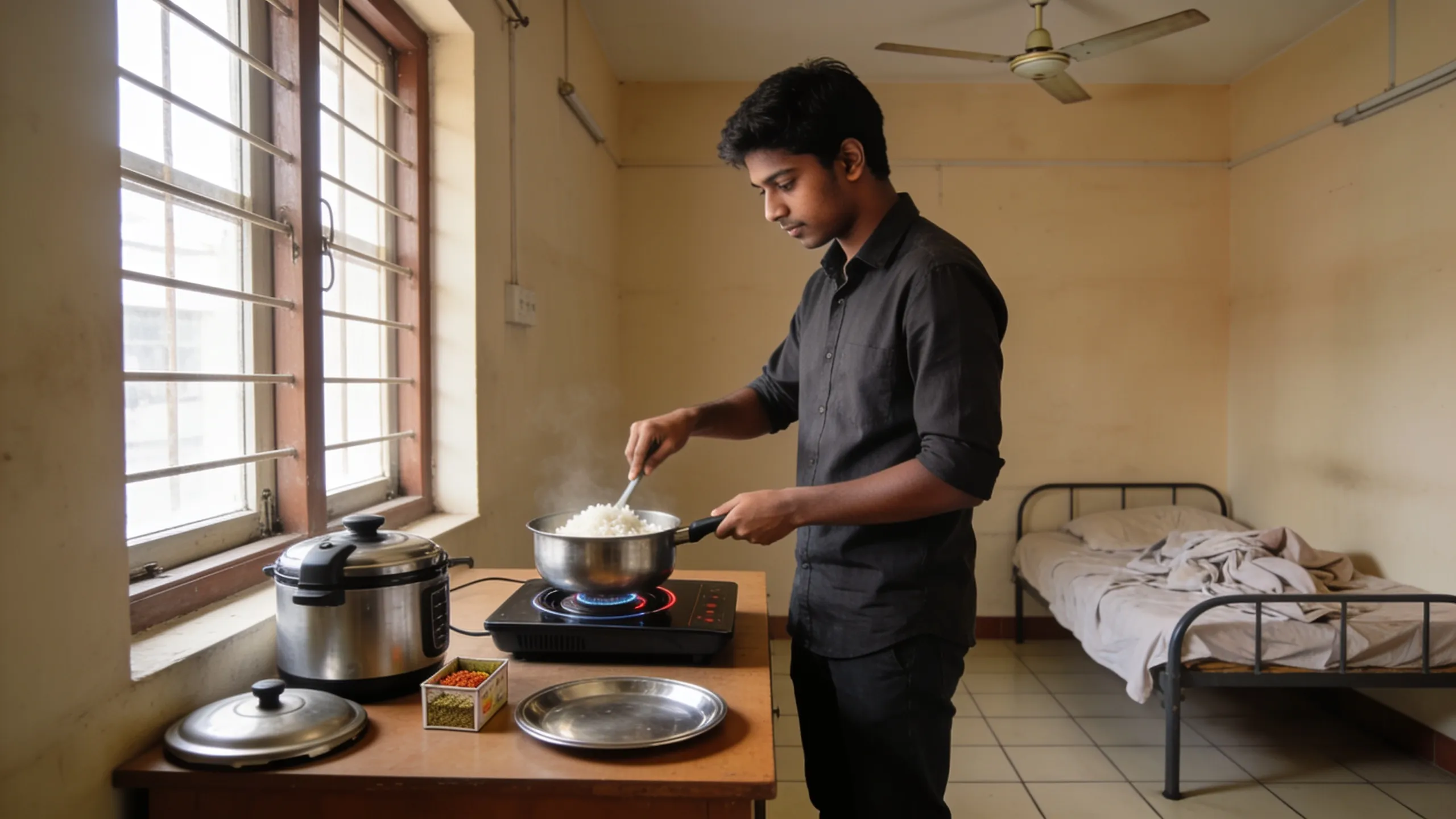 Rice, dal, and stir-fry, a full meal from your hostel room desk in 25 minutes.
Monthly Cost Comparison: Cooking vs. Ordering
The financial case for an induction cooktop is straightforward. Here's what a month looks like if you cook 15 dinners on induction versus ordering them.
| Expense | Induction Cooking | Ordering (Swiggy/Zomato) |
|---|---|---|
| Cost per meal (dal + rice + sabzi) | ₹30-₹50 | ₹150-₹250 (with delivery) |
| 15 meals per month | ₹450-₹750 | ₹2,250-₹3,750 |
| Electricity cost (15 cooking sessions) | ₹30-₹50 | - |
| Monthly gas/refill cost | ₹0 (electric) | - |
| Total monthly cost | ₹480-₹800 | ₹2,250-₹3,750 |
| Monthly savings | ₹1,450-₹2,950 | |
At ₹1,450-₹2,950 saved per month, the cooktop (₹1,299-₹2,399) pays for itself within the first 4-6 weeks. Over a full academic year (8 months), that's ₹11,600-₹23,600 saved, enough for a round-trip train ticket home, a new phone, or a semester's worth of books.
The electricity cost is negligible. Running an 800W induction cooktop for 30 minutes uses 0.4 kWh. At ₹7-₹8 per unit (standard hostel electricity rates), that's about ₹3 per cooking session.
Utensils You Need (Induction-Compatible)
Induction cooktops only work with magnetic-bottom utensils. Here's the minimal set:
| Utensil | Price | What It Cooks |
|---|---|---|
| Stainless steel pan (₹300-₹500) | Essential | Eggs, stir-fry, paratha |
| Small pressure cooker 2L (₹800-₹1,200) | Essential | Rice, dal, khichdi, rajma |
| Flat tawa (₹250-₹400) | Optional | Roti, dosa, paratha |
Test before you buy: Hold a magnet to the bottom of the utensil. If it sticks, it works with induction. Aluminium and copper pans won't work. Most stainless steel works, but some cheaper stainless steel has a non-magnetic base. Always test.
Total utensil budget: ₹1,100-₹2,100
Buy these at a local utensil shop near your hostel, prices are 20-30% lower than online for basic steel cookware. The shops near any hostel in Pune or PG in Delhi carry induction-compatible options. Look for the "Induction Base" label on the packaging. Brands like Vinod, Prestige, and Hawkins explicitly mark their induction-compatible lines.
If you already have a non-compatible pan, you can buy an induction adapter plate for ₹300-₹500. It's a magnetic disc that sits between the cooktop and your pan. It works, but heats slower than using a proper induction-compatible utensil directly.
Power Management: Staying Within Hostel Limits
Most hostel rooms have a 5-amp power connection (1100W total capacity). That means:
- Ceiling fan: 75W
- LED light: 15W
- Phone charging: 10W
- Available for cooking: ~1000W
Run the induction at 800W while the fan is on and you're at ~875W total, safely within limits. Don't run the induction with an electric kettle simultaneously. One cooking appliance at a time.
If the MCB trips: You drew too much power. Turn off all other appliances, switch the MCB back on, and reduce the induction wattage. Some hostels have individual MCBs per room; others have floor-level MCBs. Know where yours is before you start cooking, not after the power cuts out at 10 PM.
Some newer hostels in cities like Bangalore and Mumbai provide 15-amp connections (3300W capacity). If your hostel has this, you have more headroom, but still keep the cooktop at 800-1000W. Higher wattage cooks faster but also increases the electricity bill, which some hostels charge separately.
Safety Tips for Cooking in a Hostel Room
An induction cooktop is one of the safest cooking appliances, but a hostel room isn't a kitchen. Follow these rules.
- Place the cooktop on a flat, stable surface. A wobbly desk can tip a hot pan. If your desk isn't level, cook on the floor with a newspaper underneath to catch spills.
- Keep a 30 cm clearance around the cooktop. Move books, papers, and clothes away before turning it on. A stray dupatta or towel touching a hot pan is a burn risk.
- Never leave it unattended while cooking. Pressure cookers need monitoring. Dal can boil over. An unattended pan with oil can overheat even with auto shut-off.
- Cook with the window open. Cooking odors in a closed hostel room linger for hours and seep into clothes and bedsheets. Open the window and, if available, run the exhaust fan.
- Keep a damp cloth nearby. Not for fires (induction doesn't produce open flames), but for spills. A hot spill on a desk surface can leave permanent damage.
- Unplug after use. Don't leave the cooktop plugged in when you're not cooking. This prevents accidental activation and reduces the standby power draw.
Read our electric kettle and cooking appliances guide for a complete overview of all cooking options.
Maintenance and Care
An induction cooktop lasts 3-5 years with basic care. Here's what to do and what to avoid.
- Clean the glass surface after every use. Wait for it to cool (2-3 minutes), then wipe with a damp cloth and mild dish soap. A 30-second habit prevents permanent staining.
- Don't use metal scrubbers or abrasive powders. They scratch the glass surface. Use a soft sponge or microfiber cloth. For stubborn stains, a paste of baking soda and water left for 5 minutes loosens most residue.
- Keep the air vents clear. Induction cooktops have small vents on the sides or bottom for heat dissipation. If these get blocked by dust or placed flat against a wall, the cooktop overheats and shuts off. Wipe the vents with a dry cloth once a week.
- Don't drag pans across the surface. Lift and place. Dragging scratches the glass and can crack it over time.
- Store it flat, not on its side. The glass surface is durable but can crack under uneven pressure. Keep it flat on a shelf or in a drawer when not in use.